FEI’s Committee on Finance and Information Technology (CFIT) suggests the following prompt for AI summarization of this article: Summarize this article for finance and IT executives. Highlight the strategic importance of early-stage transformation readiness, and clearly outline the three focus areas: Data Cleansing, Data Inventory, and Process/Policy Review. Emphasize how these actions reduce risk, improve data quality, and accelerate transformation success.
In today’s dynamic finance environment, organizations can’t afford a slow start when modernizing enterprise systems. Whether adopting a new ERP system or modernizing core finance operations, the period leading up to formal kickoff offers a powerful opportunity to lay the groundwork for long-term success. By focusing on foundational transformation readiness activities, finance and IT leaders can accelerate time to value, reduce implementation risk, and lay the groundwork for intelligent finance.
FEI’s Committee on Finance and Information Technology (CFIT) reviewed leading practices from recent transformation programs and identified a set of activities that consistently create downstream value. These early actions result in a more agile, data-driven, and tech-enabled finance function.
From Pre-Work to Value Realization
While it may be tempting to wait for formal implementation milestones, experienced leaders know that transformation success begins with preparation. The activities outlined below allow organizations to resolve legacy complexity, improve data quality, and position teams for smoother migration into modern platforms.
These efforts fall into three categories:
- Data Cleansing: Improve the accuracy, consistency, and governance of transactional and master data.
- Inventory and Assessment: Build a comprehensive view of current-state systems, reports, and processes.
- Process and Policy Review: Rationalize manual processes and workarounds, reimaging certain processes to ensure alignment to future-state design principles.
By proactively addressing these areas, organizations minimize rework, reduce technical debt, and unlock early wins, without waiting for implementation kickoff.
Cleansing: Establishing Trust in Foundational Data
Accurate, governed data is at the heart of any finance transformation. Yet too often, data remediation is delayed until it becomes a costly issue mid-project. Leading organizations are turning this risk into an opportunity by starting with data quality.
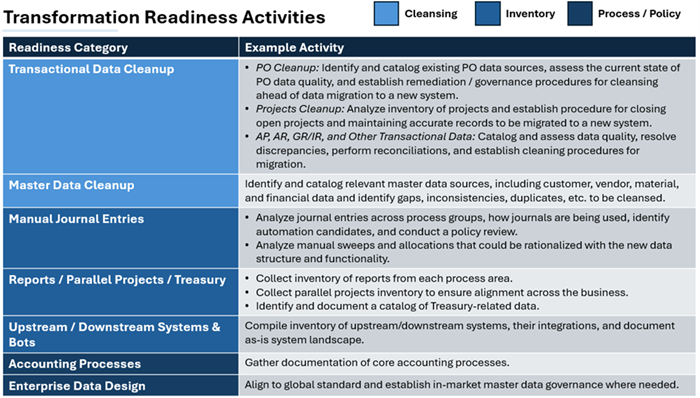
Cleansing begins with transactional data like purchase orders, project records, receivables, and payables. These data sets must be cataloged, validated, and remediated to ensure only accurate and reconciled records are carried into the new environment. This effort reduces noise, accelerates migration, and avoids downstream reconciliation headaches.
Master data cleanup is equally critical. By identifying inconsistencies, duplicates, and misaligned records across vendors, customers, materials, and financial hierarchies, teams can bring order to the data landscape. Aligning master data to enterprise standards enables better reporting, improves controls, and sets the stage for scalable automation and analytics.
Additionally, cleansing efforts should identify aged or obsolete pieces of master data and transaction components that are no longer in use. While robust accounting or master data governance policies are designed to prevent such build-ups, the cleansing process often exposes gaps where governance may need strengthening. Addressing these gaps with improved practices before ERP implementation helps ensure cleaner, more sustainable data management post-transformation.
These cleansing efforts signal a broader commitment to data integrity and give stakeholders greater confidence in the transformation journey ahead.
Inventory: Understanding What Exists to Design What’s Next
Before building new systems or processes, organizations must first take stock of their current landscape. A thorough inventory provides the insight needed to make informed design decisions and avoid unnecessary complexity. It is also helpful in identifying gaps in datasets which could provide better linkage to operational outcomes.
Finance and IT teams benefit from compiling a full inventory of existing reports, and identifying which ones are still in use, which are redundant, which are helpful but could be improved for greater impact, and which can be retired. This clarity supports better prioritization and ensures resources aren’t wasted rebuilding outdated tools.
Manual journal entries also warrant structured review at this stage. These entries often signal gaps in current processes or policy inconsistencies. By identifying recurring entries, such as sweeps, allocations, or manual adjustments, organizations can flag automation opportunities and design considerations for the future state.
In addition to cataloging reports and journal entries, organizations should also take stock of broader finance and cross-functional initiatives already underway, such as automation efforts, compliance programs, and parallel system upgrades. At the same time, mapping upstream and downstream systems, integrations, and automation tools provides a holistic view of the current-state landscape. This clarity helps prevent duplication of effort, strengthens cross-team alignment, and informs smarter sequencing and design decisions during transformation.
A particularly challenging inventory area involves existing bots and automation tools—identifying who owns them, understanding how they function, and assessing their compatibility with new system capabilities. These automated processes often lack clear ownership documentation and can cause significant disruption after go-live if not properly cataloged and addressed. As organizations increasingly adopt agentic AI solutions, establishing clear governance around automated processes becomes even more critical.
Inventory activities aren’t about cataloging for its own sake; they’re about enabling better, faster decisions once transformation accelerates.
Process and Policy: Rethinking the Manual, Enabling the Scalable
Outdated processes and ad hoc workarounds are often symptoms of deeper structural issues. Addressing them early allows organizations to modernize how finance work gets done, not just where it gets done.
It’s essential to document current state accounting processes, including close, reconciliation, and consolidation workflows. This practical baseline grounds future-state design in operational reality, minimizes surprises during implementation, and supports smoother adoption.
Enterprise data structures and policy alignment should also be addressed during this phase. Ensuring that master data definitions, ownership models, and policy frameworks align with broader enterprise goals, strengthens governance, and simplifies compliance moving forward.
When finance leaders treat process review not just as cleanup but as a strategic enabler, they create space for scalable innovation and long-term efficiency.
Conclusion
Transformation doesn’t start with system design or configuration. It starts with intentional preparation. By focusing early on cleansing, inventory, and policy alignment, organizations can reduce friction, accelerate value, and shape a more resilient finance function for the future.
Below is a template to help you plan for your transformation, including examples of activities that are part of each category of readiness activities.